

If you are worried that your credit score is too low to buy a home, you are not alone. A lower score can make the process harder, but it does not automatically end it. Your options depend on the loan type, the lender, and the full picture of your finances. This guide explains how credit affects a mortgage, what lenders review, and the steps you can take on your own, for free.
How your credit affects your mortgage options
Lenders use your credit reports and scores to help decide whether you qualify for a loan and on what terms. In general terms, credit can affect:
- Which loan types and programs are available. Each loan type and lender sets its own minimum requirements.
- How much borrowing costs. The CFPB notes that borrowers with lower scores generally pay more and have fewer choices.
- Related costs, such as whether mortgage insurance is required and how it is priced.
Credit is only one factor. Lenders also consider income, debt, savings, and the home you want to buy. Our guide to how much house you can afford in Texas explains how debt-to-income ratio fits in.
Minimum scores vary
There is no single minimum that applies to every loan. For example, Texas State Affordable Housing Corporation (TSAHC) requires a minimum credit score of 620 for government loans and 640 for conventional loans in its down payment assistance programs, and the Texas Department of Housing and Community Affairs (TDHCA) requires a minimum score of 620 for its homebuyer programs. Lenders can require more than a program’s minimum. For details on these programs, read our guide to first-time homebuyer programs in Texas.
What lenders look at
Credit scores are built from the information in your credit reports. The CFPB lists these main categories:
- Payment history: on-time payments, missed payments, and accounts in collections.
- How much you owe: your balances compared to your credit limits or original loan amounts.
- Length of credit history.
- Credit mix: your experience with different kinds of credit.
- New credit: recent applications and newly opened accounts.
Payment history is generally the most important factor in most credit scores, according to the CFPB. A lender will also review the story behind the numbers, so be ready to explain any late payments, collections, or other past problems.
Step 1: Check your credit reports for free
Start by seeing exactly what lenders will see. The three nationwide credit bureaus (Equifax, Experian, and TransUnion) offer free reports through AnnualCreditReport.com. According to the Federal Trade Commission (FTC), you can check your report from each bureau once a week for free, and AnnualCreditReport.com is the only site authorized to fill these orders. Other sites may charge you or be set up to steal your information.
Review each report for accounts you do not recognize, wrong balances, payments reported late that you paid on time, and old items that should have dropped off. Checking your own report does not hurt your score, according to the CFPB.
Step 2: Dispute errors
Mistakes happen, and fixing them is free. The FTC and the CFPB explain the basic steps:
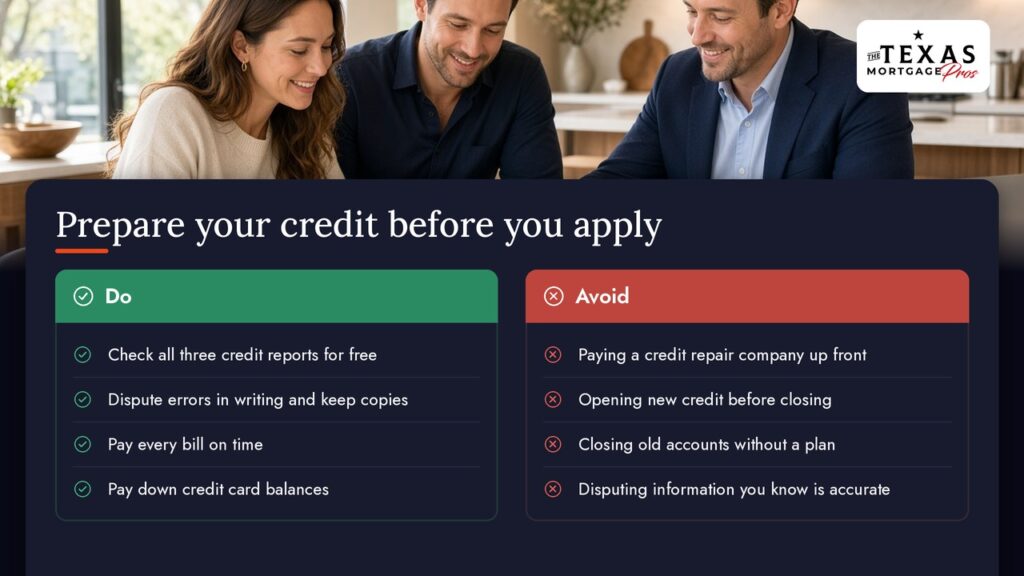
- Write to the credit bureau that shows the error. Explain what is wrong, and include copies (not originals) of supporting documents.
- Also contact the company that reported the information. Both the bureau and that company must correct information that is wrong or incomplete.
- Keep records of everything you send. The CFPB suggests certified mail for mailed disputes.
- Allow time. A bureau generally must investigate within 30 days of receiving your dispute, and in some cases up to 45 days.
- Follow up. If you are not satisfied with the result, you can submit a complaint to the CFPB.
If an error appears to be identity theft, the FTC directs you to IdentityTheft.gov. Because disputes take time, start well before you plan to apply.
Step 3: Improve what you can
The CFPB says there is no secret formula, but these habits can help over time:
- Pay every bill on time. If you are behind, get current and stay current. Automatic payments or reminders can help.
- Pay down credit card balances. Scoring models look at how close you are to your credit limits. The CFPB says experts commonly advise using no more than 30 percent of your total limit, and some suggest less.
- Do not close old accounts without thinking it through. Closing cards and moving balances onto one card can raise the share of your limit you are using.
- Avoid new credit before and during your mortgage process. Applying for several cards or loans in a short time can lower your score, and new debt changes your debt-to-income ratio. Hold off on financing a car, furniture, or other big purchases until after closing, and ask your loan officer before opening any new account.
- Be patient. The CFPB says it may take six months to a year or more of consistent on-time payments to raise scores significantly.
Shopping for a mortgage
Comparing lenders is fine. The CFPB says that when you shop for a mortgage with multiple lenders, the extra credit checks should not hurt your score as long as they occur within a short window, roughly 45 days.
Building credit history if you have little or none
You need to use credit to build a history. The CFPB suggests using credit cards or loans responsibly, paying on time, and considering products designed to help people build credit. It also recommends a HUD-approved housing counselor for people who do not have a credit report or score. You can find a HUD-approved housing counseling agency on HUD’s website.
Rapid rescore: one option to ask your lender about
After you pay down a balance or correct an error, it can take weeks for the change to appear on your report. A rapid rescore is a service that some mortgage lenders can use to ask the credit bureaus to update a report faster once you have documentation of a change. A few things to know:
- You cannot order it yourself. It goes through a lender or loan officer.
- Never request that the vendor offer it, and it only makes sense in specific situations.
- It does not remove accurate negative information, nor does it guarantee a higher score.
If you think it could apply to you, ask a loan officer whether it is an option and whether it makes sense.
Beware of credit repair scams
Many companies advertise quick fixes. The FTC warns that anything a credit repair company can do, you can do yourself for little or no cost. Signs of a scam include companies that:
- insist you pay them before they help you,
- tell you not to contact the credit bureaus directly,
- tell you to dispute information you know is accurate,
- tell you to lie on credit or loan applications, or to file a false identity theft report, or
- do not explain your legal rights.
Under the Credit Repair Organizations Act, credit repair companies generally cannot charge you before services are fully performed, must give you a written contract, and cannot legally remove accurate, up-to-date negative information. If you suspect a scam, report it to the FTC at ReportFraud.ftc.gov.
| Step | Free resource | Why it helps |
|---|---|---|
| Check reports | AnnualCreditReport.com | See what lenders see |
| Dispute errors | Credit bureaus, then the CFPB if needed | Correct wrong or incomplete items |
| Reduce balances and pay on time | Your own budget | Payment history and balances are main score factors |
| Get guidance | HUD-approved housing counselor | Help building a plan for your situation |
Frequently asked questions
Can I buy a home with a low credit score?
Possibly. It depends on the loan type, the lender, and your overall financial situation. A loan officer can review your reports and explain which options may be worth considering now and which may be worth waiting on.
Should I wait to apply until my score improves?
It depends. Some buyers benefit from a few months of preparation, and others can move forward. A loan officer can help you decide. Credit still in progress? The Rent-to-Own Loan Program lets you rent a home now while your payments build earned equity.
Does checking my own credit report lower my score?
No. According to the CFPB, requesting your own credit report does not hurt your score.
Is a credit repair company worth paying for?
The FTC says anything a credit repair company can do, you can do yourself for little or no cost, and it advises caution with any company that asks for payment up front.
Talk with a local loan officer
A loan officer at The Texas Mortgage Pros can review your situation, explain how credit may affect your options, and discuss what to do before you apply. You can start a pre-qualification, visit our Texas down payment assistance page, or call (877) 280-4833.
Official sources
- FTC: Free credit reports and disputing errors on your credit reports
- FTC: Spot the scams when fixing your credit and Fixing your credit FAQs
- CFPB: How do I dispute an error on my credit report?
- CFPB: How to rebuild your credit and How do I get and keep a good credit score?
- CFPB: Buying a home? The first step is to check your credit
- TSAHC down payment assistance and TDHCA Homebuyer Program
The Texas Mortgage Pros, NMLS #2665861. This article is for general information only. It is not a commitment to lend or extend credit, and it is not legal, tax, financial, or credit repair advice. Credit requirements, program rules, and limits are subject to change without notice, and all loans are subject to credit approval and other restrictions. The Texas Mortgage Pros is not affiliated with or endorsed by the FTC, CFPB, HUD, FHA, the U.S. Department of Veterans Affairs, USDA, TSAHC, or TDHCA, and this is not a government document. Last verified October 2, 2026.
Equal Housing Opportunity. We do business in accordance with federal fair lending laws.
