

Refinancing means replacing your current mortgage with a new one. It can be a smart move for some homeowners and a costly one for others. The right answer depends on your goal, how long you plan to stay in the home, and what the new loan will cost. This guide walks through the common reasons to refinance, the Texas rules that surprise many homeowners, and the situations where it may not make sense.
Common reasons to refinance
The Consumer Financial Protection Bureau (CFPB) notes that homeowners often refinance to lower their mortgage costs, but there are usually trade-offs. Here are the goals we hear most often.
Lower the monthly payment
A new loan may come with different terms that reduce your monthly payment. But the CFPB cautions that a new loan means a new loan term, which could be longer. That can mean a lower monthly payment but more money paid in total over time.
Shorten the term
Moving to a shorter term can mean paying off the loan faster and paying less total interest, but your monthly payment could be higher, according to the CFPB. Our guide to how much house you can afford in Texas explains how debt-to-income ratio works.
Switch from an adjustable-rate to a fixed-rate loan
Refinancing from an adjustable-rate mortgage (ARM) to a fixed-rate loan can bring more certainty. The CFPB notes that principal and interest payments do not change on a fixed-rate loan, but they can change a lot on an adjustable-rate loan.
Remove mortgage insurance
For conventional loans, federal law gives you the right to ask your servicer to cancel private mortgage insurance (PMI) once you have built sufficient equity and meet the requirements, so refinancing is not always the only option. FHA, VA, and USDA loans each handle insurance or fees differently. Ask your servicer and a loan officer to compare your options before you pay refinance costs just to remove PMI.
Take cash out
A cash-out refinance replaces your loan with a larger one and gives you the difference in cash. It increases the amount you owe and uses your home as security. In Tit, it comes with special rules, covered below.
The break-even idea, in plain words
Refinancing is not free, so a useful question is: how long will it take to earn back what I spend? To estimate that, divide the total cost of the new loan by the amount you expect to save each month. The result is approximately the number of months it takes to break even. If you may sell or refinance again before then, the refinance may cost you more than it saves.
This is only an estimate. Ask your loan officer to show you both the monthly difference and the total cost over time for each option.
What refinancing costs
You may pay many of the same kinds of costs you paid when you bought, such as lender fees, an appraisal, title charges, and prepaid items. Here is how to evaluate them:
- Use the Loan Estimate. The CFPB recommends comparing upfront loan costs, lender credits, and “cash to close” on Loan Estimates from different lenders.
- Be careful with “no-closing-cost” offers. According to the CFPB, these typically work by charging a higher interest rate to cover the costs, or by adding the costs to your loan amount. Either way, you may pay more over time.
- Review your escrow account. A new loan usually sets up a new escrow account for taxes and insurance. See our guide to Texas property taxes and your monthly mortgage payment.
- Know your right to cancel. For most refinances of your principal home, federal law gives you three business days after closing to cancel, according to the CFPB. Cancellation requires written notice.
Texas rules: home equity loans and HELOCs
Texas protects homesteads under Article XVI, Section 50 of the Texas Constitution. A few rules matter if you want to borrow against your equity:
Cash-out is a “home equity loan” in Texas
Under the Texas Constitution, a refinance of a homestead loan that includes additional funds beyond reasonable refinancing costs generally must meet the rules for a Section 50(a)(6) extension of credit, commonly called a Texas home equity loan. According to the Texas Office of Consumer Credit Commissioner (OCCC), the constitution requires, among other things:
- The loan plus all other liens against the home cannot exceed 80 percent of the home’s fair market value.
- A 12-day waiting period after you apply and receive the required notice before the loan can close, plus at least one business day after you receive a final itemized disclosure of closing costs.
- A three-day right to rescind after closing.
- No prepayment penalty on the loan.
- Only one such loan secured by your home at a time, with a one-year waiting period between loans, with limited exceptions.
- Closing only at the lender’s office, a title company, or an attorney’s office.
- A cap on the fees and charges the lender can collect.
The OCCC’s required notice also warns that if you do not repay the loan, the lender may foreclose and sell your home. Texas also has separate rules for refinancing an existing home equity loan, so ask your loan officer how they apply to you.
Home equity loan vs. HELOC
| Home equity loan (cash-out) | Home equity line of credit (HELOC), Section 50(t) | |
|---|---|---|
| How you get the money | Funds at closing | An open-end line you can borrow from, repay, and borrow again |
| Limit on borrowing against the home | 80 percent combined with other liens | 80 percent combined when the line is established; other limits apply |
| Texas-specific restrictions | 12-day wait, rescission, one-at-a-time | Restrictions on how advances are made, such as no card access to the line |
A HELOC is a separate loan in addition to your first mortgage, while a cash-out refinance replaces it.
Streamline options
If your current loan is an FHA or VA loan, you may be eligible for a streamline refinance. HUD describes the FHA streamline as a refinance of an existing FHA-insured loan with limited credit documentation and underwriting. It generally requires a “net tangible benefit,” and it does not mean there are no costs. The VA offers an Interest Rate Reduction Refinance Loan (IRRRL), a “streamline” for existing VA-backed loans that you apply for through a lender rather than directly through the VA. Neither is a cash-out loan, and neither is guaranteed to fit your situation.
The VA also warns veterans about unsolicited refinance offers that look official and sound too good to be true. Compare any offer to your current loan before you sign.
When refinancing may not make sense
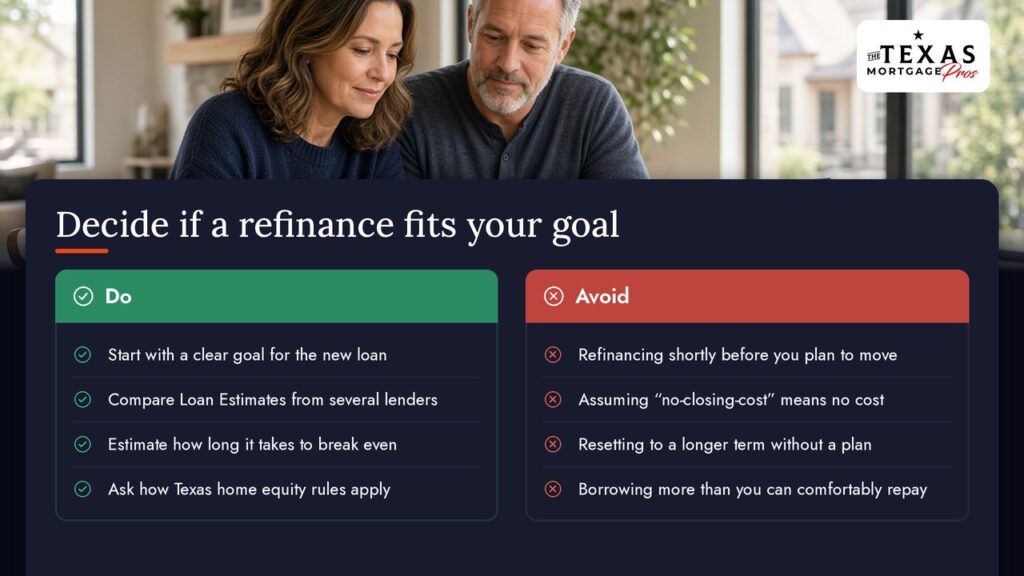
- You plan to move soon. You may not stay long enough to recover the costs.
- You are resetting the clock. A longer new term can lower the payment while raising the total cost. If you are far into your current loan, think carefully.
- Costs are high or financed. Rolling costs into the loan, or taking a higher interest rate to cover them, can reduce your benefit.
- You would borrow more than you can comfortably repay. Your home secures a cash-out loan.
- Your credit has changed. A refinance application involves a credit review. Read our guide to buying with a low credit score and how to improve it before you apply.
Also check for a prepayment penalty. The CFPB says to check your mortgage note, any addendum, and your Closing Disclosure for “prepayment” language, or ask your servicer. Texas home equity loans cannot carry a prepayment penalty.
Questions to ask before you refinance
- What is my goal, and does this loan actually serve it?
- What is the total cost, and how is it paid?
- How long until I break even, and how long do I plan to stay?
- Do any Texas home equity rules apply to this loan?
Frequently asked questions
Will refinancing lower my payment?
Not necessarily. It depends on the terms of the new loan, including its term length and costs. Ask for a side-by-side comparison.
Can I cancel after I close?
For most refinances of your principal home, you have three business days to cancel in writing, according to the CFPB. Texas home equity loans also include a three-day right to rescind.
Is a cash-out refinance the same as a HELOC?
No. A cash-out refinance replaces your first mortgage with a new loan, while a HELOC is a separate line of credit. Both are governed by Texas homestead rules.
Talk with a local loan officer
A loan officer at The Texas Mortgage Pros can review your goals, compare options, and explain the applicable Texas rules. Learn more about our refinance options, start a pre-qualification, or call (877) 280-4833.
Official sources
- CFPB: Should I refinance?
- CFPB: comparing Loan Estimates
- CFPB: Right of rescission
- Texas Constitution, Article XVI, Section 50
- Texas OCCC: Home equity consumer disclosure
- HUD: FHA streamline refinance
- VA: Interest rate reduction refinance loan
The Texas Mortgage Pros, NMLS #2665861. This article is for general information only. It is not a commitment to lend or extend credit, and it is not legal, tax, or financial advice. Loan terms, program rules, and Texas lending requirements are subject to change without notice. All loans are subject to credit approval, property valuation, and other restrictions. Refinancing may increase the total amount you pay over the life of the loan. The Texas Mortgage Pros is not affiliated with or endorsed by the CFPB, the Texas Office of Consumer Credit Commissioner, HUD, FHA, the U.S. Department of Veterans Affairs, USDA, or any government agency, and this is not a government document. Last verified October 2, 2026.
Equal Housing Opportunity. We do business in accordance with federal fair lending laws.
